 Tesseract
How Tesseract was built: 3.5 million lines in five months
Tesseract began as a Chrome extension in March 2026. Five months on: 13,897 commits, 3.5 million lines of code and 1,000+ new people in three weeks.
On March 30, 2026, Tesseract was a Chrome extension. It put Claude Code in the browser’s side panel, so the agent could see the web page you were fixing.
Today, November 18, 2026, Tesseract is a free desktop app for Mac, Windows and Linux, with a web version, an iPhone app, a command-line agent and a browser extension. It runs 14 coding agents, a different one in each conversation, all able to work at the same time. It ships 77 built-in tools. And in the last three weeks, more than 1,000 new people started using it.
This post is the journey in numbers. Every number comes straight from our git history, our coding agents’ own logs and our analytics. How we counted each one is at the end.
Where did Tesseract start?
It started with one small idea: let the coding agent see what you see. The first commit, on March 30, 2026, was a Chrome extension for visual web debugging with Claude Code. We made 41 commits that first day. It kept growing: file attachments, run-mode controls, a release on the Chrome Web Store.
Using it every day taught us something bigger. People don’t want an agent stuck in one browser tab. They want it next to all their work: the code, the documents, the terminal, the preview, and their other computers.
So on June 7, 2026 we made the first commit of Tesseract itself: a desktop app and a web app in one repository, 249 files and 27,120 lines of code. The next day, version 0.2.1 shipped for Mac (Apple silicon and Intel) and Windows.
What is Tesseract today?
Five months later, that first desktop app has grown into a family of products:
- The desktop app for Mac, Windows and Linux. It installs and updates itself.
- The web app at app.tesseract.dev.
- The iPhone app, to follow your agents and answer them from anywhere.
- A command-line agent,
tesseract-agenton npm. - A browser extension, where it all began.
- Three free apps of its own: Tesseract Remote Desktop (see and control any of your computers from another one), Tesseract Mesh (all your computers on one private network, by name) and Tesseract Atrium (channels, threads and AI catch-ups for your team).
Inside the app:
- 14 coding agents: Claude Code, OpenAI Codex, Gemini CLI, Antigravity CLI, OpenCode, Kimi Code, Qwen Code, MiniMax Code, CodeBuddy, Grok Build, Cursor, Hermes Agent, OpenClaw and NanoClaw. Pick a different one for each conversation.
- 77 built-in tools in 7 groups: documents and office, video and motion, audio and voice, pictures and design, building apps and sites, assistants and automation, and connecting things.
- Real editors: a video editor with a full timeline, a layered photo editor, and Word, spreadsheet and PDF editors. The agent works in them with you.
- 250+ video effects and 220+ templates in 14 design themes.
- 30 connections to 20 AI and media providers, among them Anthropic, OpenAI, Google, xAI, DeepSeek, Moonshot, MiniMax, ElevenLabs, fal and OpenRouter.
Under the hood, all of it lives in one repository: 27 apps, 38 shared packages and 20 Rust crates.
How fast did the code move?
Fast, and faster every month. In 165 days we made 13,897 commits, an average of 84 a day.
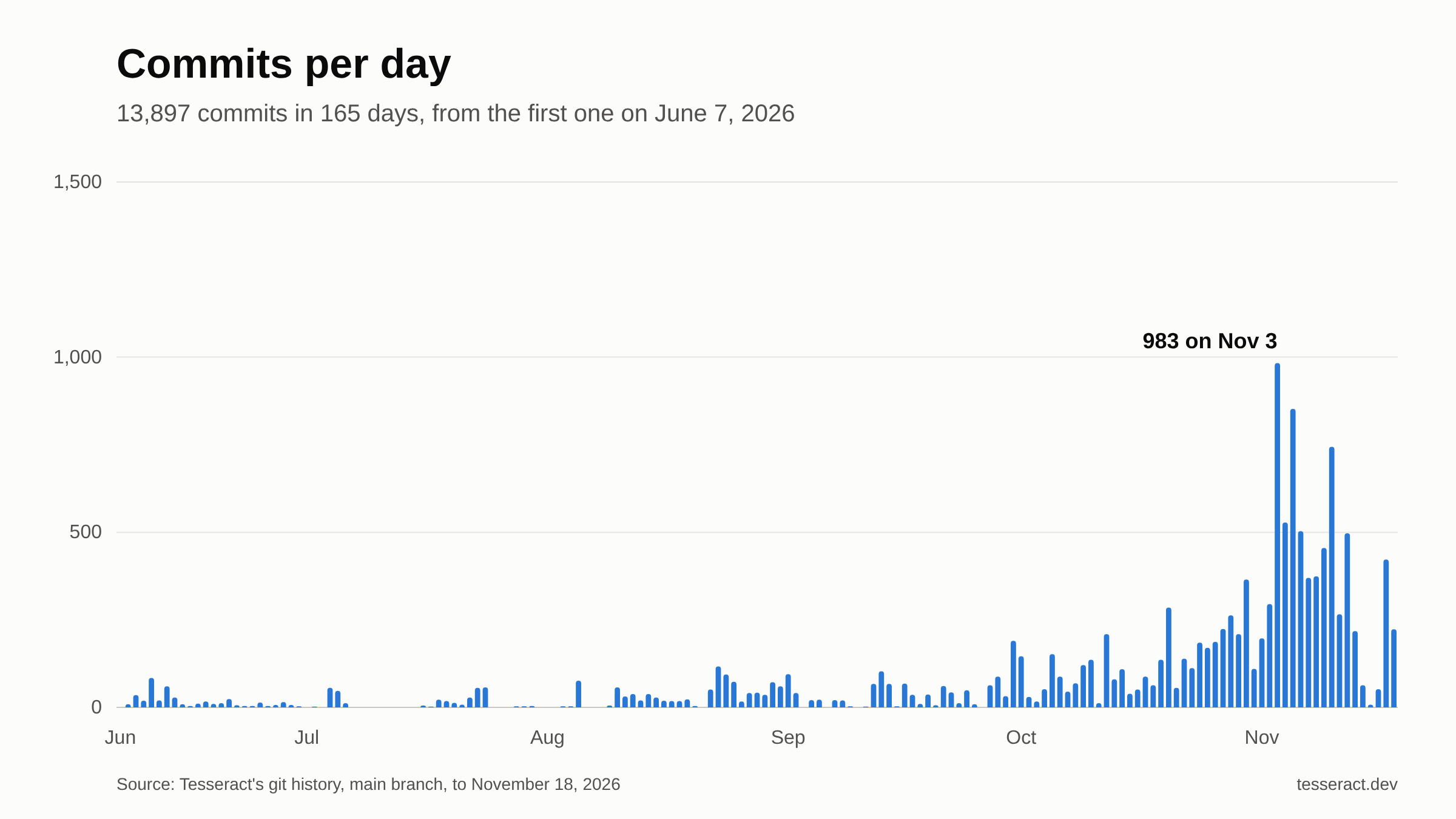
Month by month:
| Month | Commits |
|---|---|
| June | 407 |
| July | 337 |
| August | 984 |
| September | 1,171 |
| October | 3,948 |
| November (first 18 days) | 7,050 |
The busiest day was November 3, with 983 commits. That is about 41 every hour, around the clock. In the first 18 days of November we made more commits than in all the months before put together.
How big is the code now?
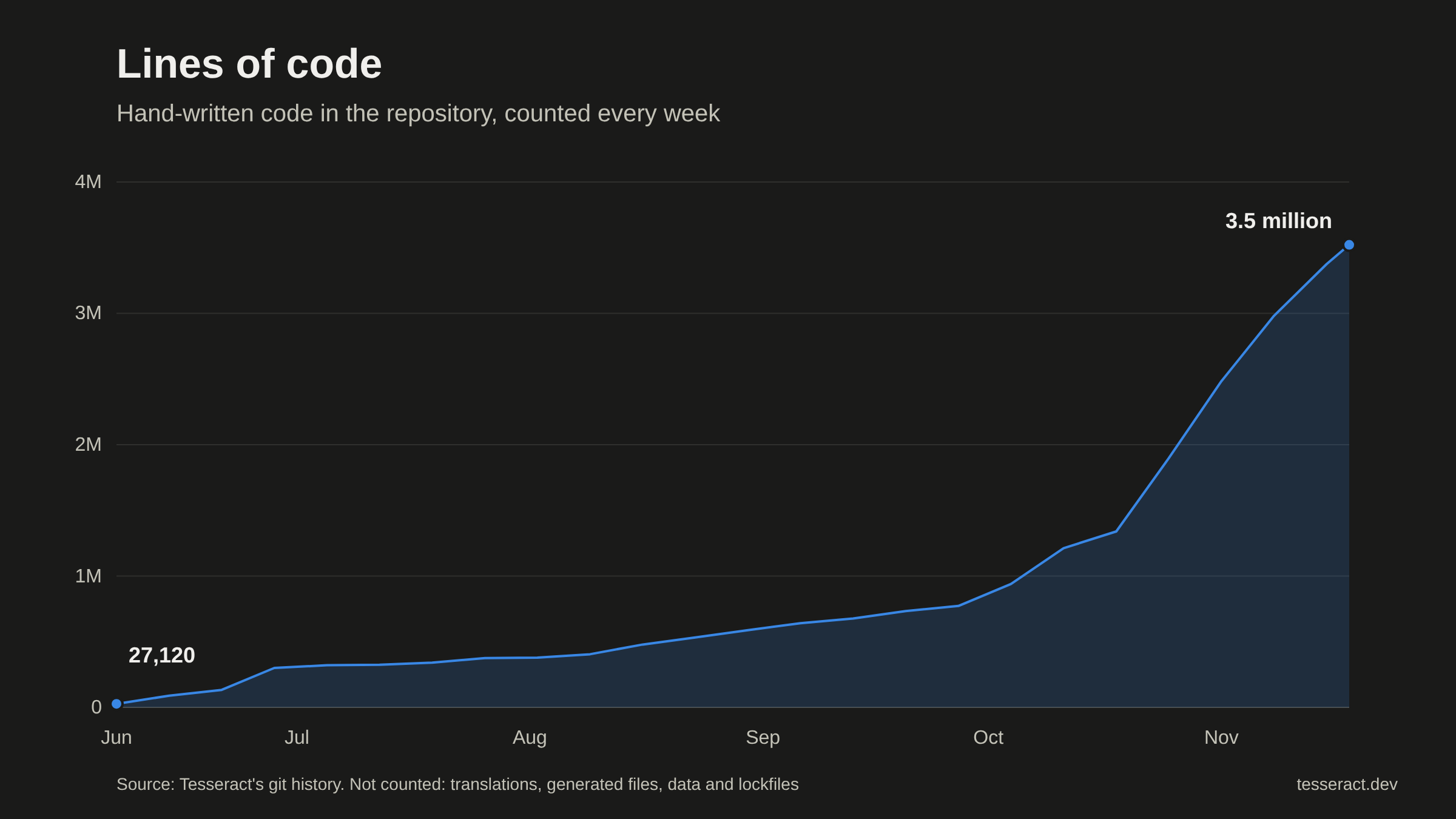
On June 7 the code was 27,120 lines. Today it is 3,521,070 lines of hand-written code in 16,416 files. That doesn’t count translations, generated files, bundled builds, data or lockfiles.
Some milestones:
- 1 million lines in early October, four months in.
- From 1.34 million on October 18 to 2.98 million on November 8: more than double in three weeks.
- About 1.1 million lines are tests, close to a third of the code. That is how a product grows this fast and keeps working.
By language: TypeScript is the largest (2.9 million lines across the desktop, web, server and agent). Then Dart for the phone apps (208,000), Rust for the networking engine (101,000), Python (75,000), and Swift and Go for the parts that talk to the operating system.
How many AI tokens did it take?
Tesseract is built with the same coding agents it runs. That takes a lot of AI.
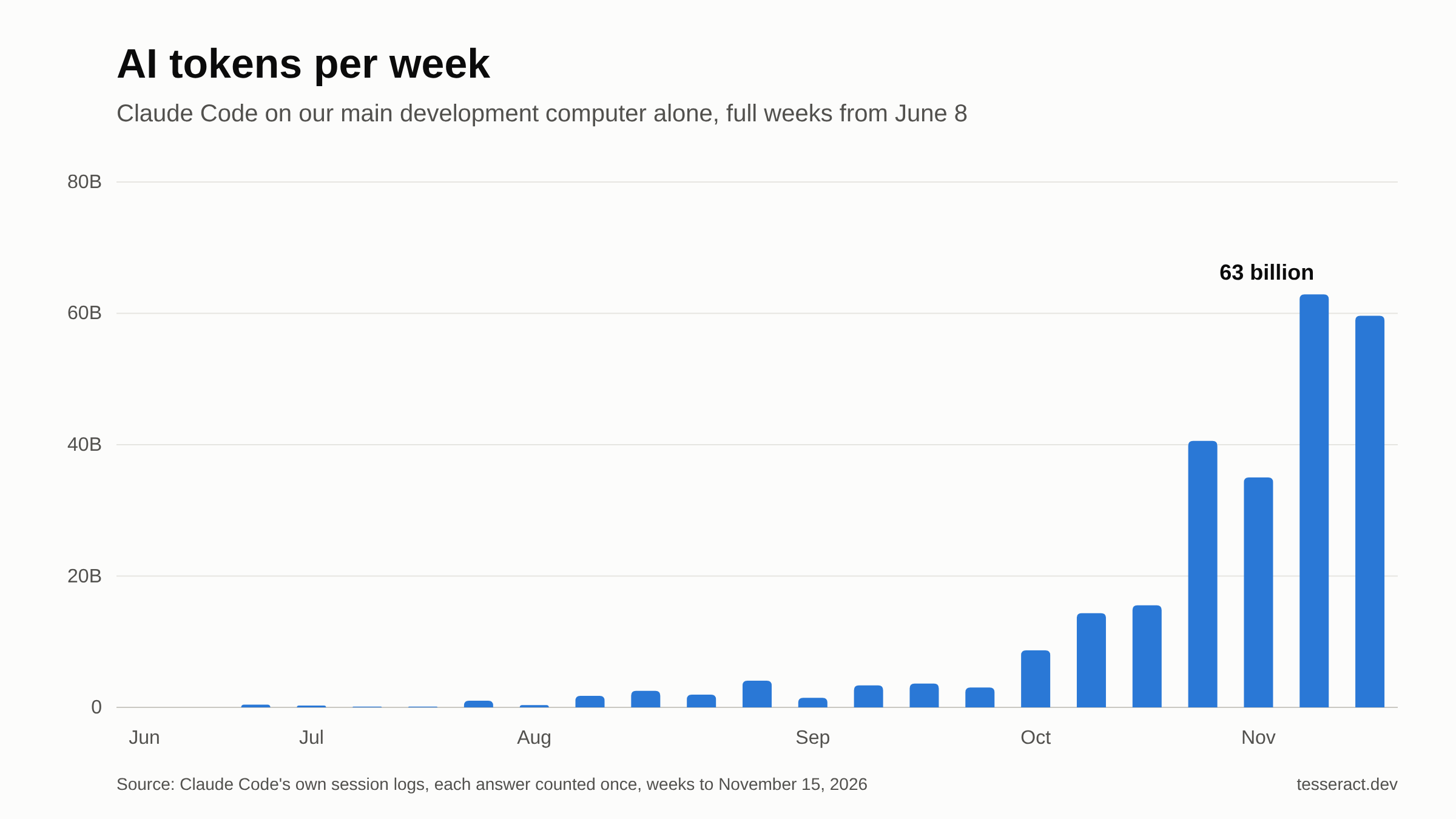
On our main development computer alone, our coding agents’ logs hold 291 billion tokens in Claude Code, from 850,286 answers, each answer counted once. The OpenAI Codex logs on the same computer add 2.6 billion. That is one computer: our build servers and the app’s own agents add more on top.
Where the tokens go:
- 282 billion are cache reads. That is the agent re-reading the project as it works, again and again, so every change fits the code around it.
- 7.7 billion were written to the cache. That is new context, such as files, docs and test results.
- 736 million are output tokens. That is the code, tests and documents the agents wrote.
The weekly curve tells the same story as the commits. Through the summer we used a few billion tokens a week. In the week of November 2 it was 63 billion. We run many agents at once now, each on its own task.
How quickly did people find it?
Very quickly. From October 28 to November 18, more than 1,000 people opened Tesseract for the first time. That is about seven times as many as in all the weeks before.
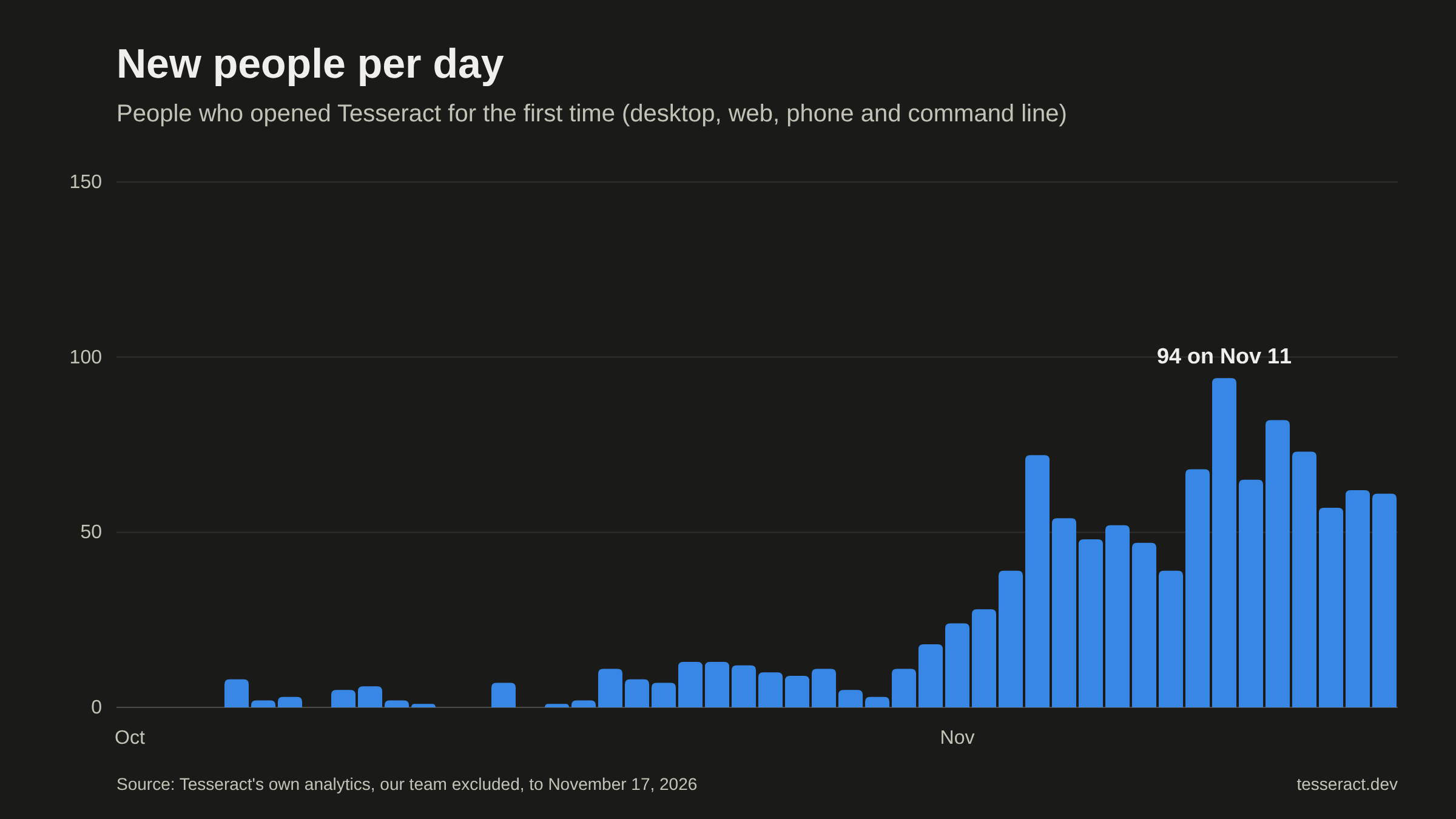
- New people per week went from 100 to 501 in two weeks, five times as many.
- 965 new people in the first 17 days of November, against 168 in all of October.
- People in 95 countries use Tesseract. The most come from the United States, Germany, India, Brazil, Turkey, China, France and Japan.
- Visitors from 131 countries came to tesseract.dev in the last 30 days.
They use it everywhere: the desktop app, the web app, the iPhone app and the command line.
What made this speed possible?
Three things, and the product is built on each of them.
Many agents at once. On a busy day, many agent conversations run side by side, each on its own task, each with the coding agent that suits it best. That is exactly what Tesseract gives you: 14 coding agents, a different one in each conversation, all able to work at the same time.
Small steps, tested every time. Every change is one small commit, checked by its tests and pushed straight to the main branch. With nearly 1,000 commits on a busy day, small steps are what keep the product working.
Tesseract builds Tesseract. We use the app every day to build the app, and our own marketing assistant runs on Tesseract too.
How did we count?
- Commits: every commit on the main branch of the Tesseract repository, from June 7 to November 18, 2026, grouped by day.
- Lines of code: a snapshot of the repository every week, counting lines in code files (TypeScript, Dart, Rust, Python, Swift, Go, CSS, HTML, SQL, shell and others). Translations, generated files, bundled builds, data files, type declarations and lockfiles are left out.
- Tokens: Claude Code’s session logs on our main development computer, every answer counted once by its id, plus the totals in the Codex logs. The chart shows full weeks from June 8 to November 15.
- People: Tesseract’s own analytics, with our team left out. A person is counted the first time they open any Tesseract app or the web app. Countries come from the same analytics, and from the visits to tesseract.dev.
Questions
How long did it take to build Tesseract? The first commit was on June 7, 2026, and the first release shipped the next day. Five and a half months later Tesseract has 3.5 million lines of code, 14 coding agents and 77 built-in tools. The idea started as a Chrome extension on March 30, 2026.
How many lines of code does Tesseract have? 3,521,070 lines of hand-written code on November 18, 2026, in 16,416 files. About 1.1 million of those lines are tests.
How many people use Tesseract? More than 1,000 new people started using it between October 28 and November 18, 2026. People in 95 countries use it.
Is Tesseract free? Yes. It runs on the Claude or ChatGPT subscription you already have, or on a free allowance. Tesseract itself charges nothing. Download it here.
Which AI agents does Tesseract run? Claude Code, OpenAI Codex, Gemini CLI, Antigravity CLI, OpenCode, Kimi Code, Qwen Code, MiniMax Code, CodeBuddy, Grok Build, Cursor, Hermes Agent, OpenClaw and NanoClaw, a different one in each conversation, all able to work at the same time.
Five months ago this was a side panel in Chrome. Try what it became.